Showing posts with label chuck. Show all posts

Thursday, September 19, 2013

More 2013 Cattle Mutilations Occurring in Colorado and Missouri!

August 8, 2013 | By
 
Within the past few weeks we’ve had multiple animal mutilations here in Colorado and Missouri and the ranchers involved are upset and concerned for the safety of their animals. The ranches surrounding the area of these unusual animal deaths are also worried about their livestock. Could this also happen to their animals? Multiple alarming questions still remain.
Why are the same ranchers being targeted again and again when there are other ranches nearby that don’t get hit?

Who or what is doing this? And why? For what purpose? Will humans be next, or have Human Mutilations already occurred and their stories have been covered up?

Missouri mutilation:
On July 10th, 2013, I was contacted by Lyn Mitchell from Henry County, Missouri, and was informed she just had a mutilation occurrence on her ranch. This was the second mutilation on her ranch, the first one happening in December 2011. She had located me through her brother who found an article about one of my investigations on the internet from January of 2012. She asked if I could come down and investigate her mutilation case, but unfortunately she didn’t know I live in Colorado while she lives in Missouri. But not to worry… I asked her if I could contact an experienced investigator who lives near her area, and she agreed, so I asked Margie Kay from the Kansas City Missouri location to help out. Margie agreed to investigate the mutilation, so I forwarded Lyn’s information to her.

231
( Photo courtesy Lyn Mitchell, first mutilation in 2011 )
This heifer calf about 600 pounds died in December of 2011 and besides the unusual incisions shown here, the calf was also missing its tail and anal region.
IMG_0827
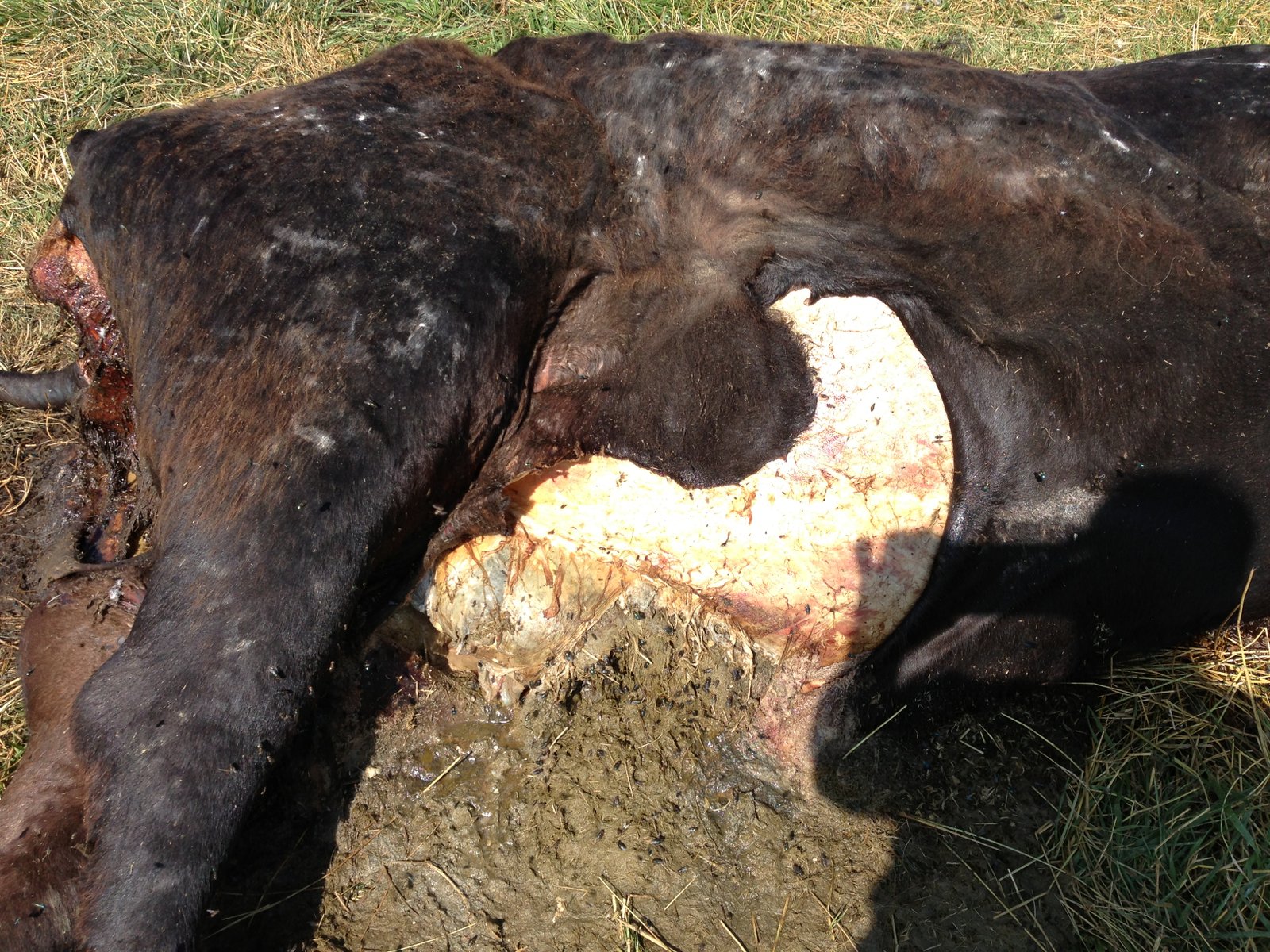
( Picture of second mutilation, courtesy Lyn Mitchell )

On July 13th Margie Kay with fellow investigator Larry Jordan, met with the rancher and headed to the location of the mutilation. The animal had already been moved by the rancher, but both investigators were surprised to see a circular depressed area on the ground where the animal was laying. Soil samples were taken for future analysis.

The rancher stated the animal was found on July 10th, and was lying on her left side. The anal area, tongue and udder had been removed. There was evidence of bird damage, but not causing the extreme and precise cuts the rancher saw.
071913a
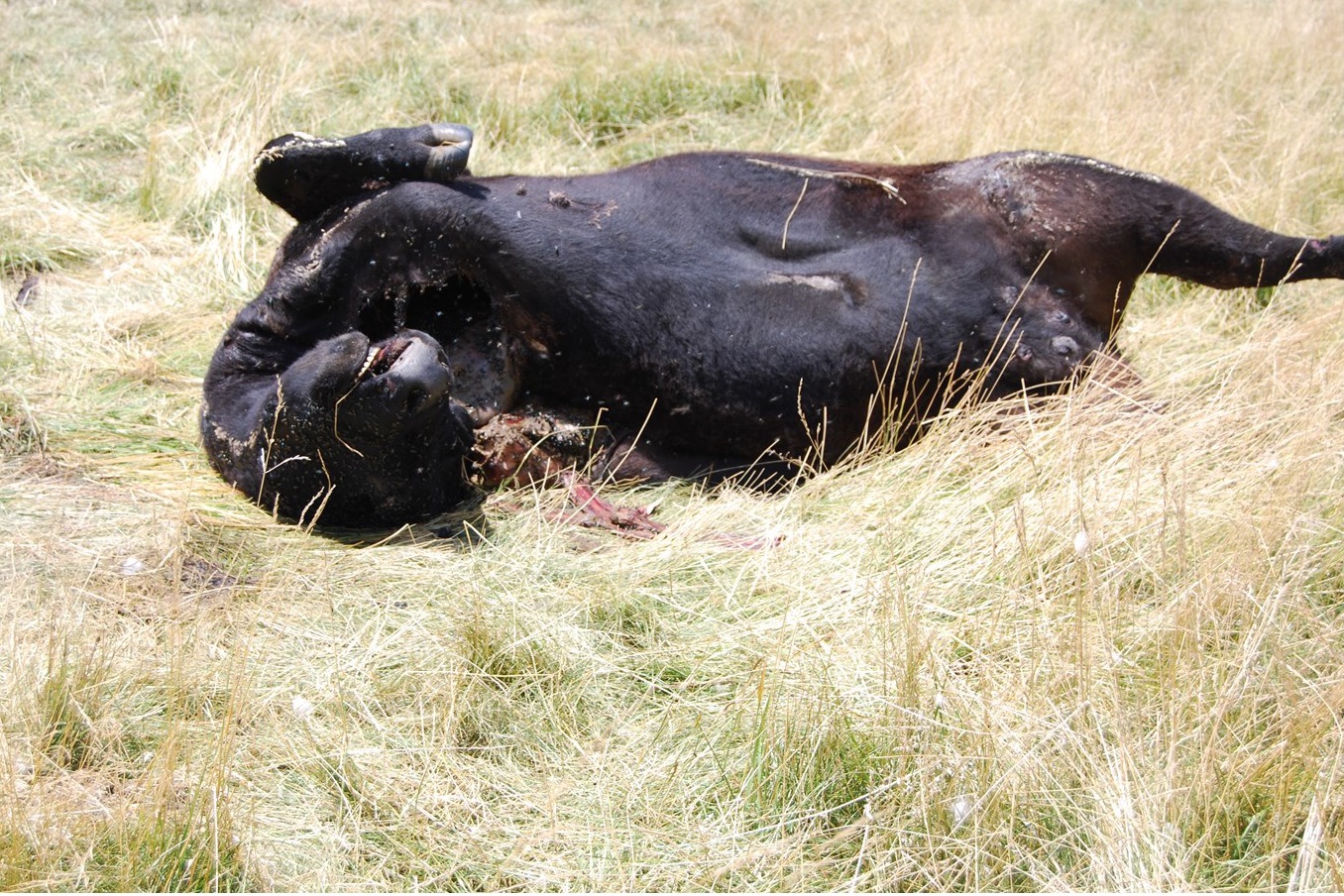
( Picture of third mutilation courtesy Margie Kay )

On July 19th, Lyn called Margie and informed her she had found another mutilated animal on her ranch, now that makes three. The rancher had called the Sheriff and veterinarian and they were on their way to the mutilation location as they spoke.

Margie and fellow investigator Larry Jordan arrived at the scene just after the veterinarian had left. The 7 year old cow was found with a cut in the front of the body between the front two legs, and the heart nearly outside of the body. All of the teats had been cut off the udder, and the tongue was cut out. There was damage to one of the eyes, but that could have been attributed to bird scavenging.

The veterinarian said there was no blood on the ground near the animal and the cuts were clean and precise. There was little blood in the chest cavity area which was unexplainable and there were no signs of predator claw or bite marks and no signs of bullet holes causing the death. This animal was estimated at about $2000.

Note: Not only do the ranchers lose what the animal is worth initially, but they also lose any future offspring the animal could have. This could estimate into the thousands of dollars of lost income to the rancher.

Colorado Mutilation:
On July 11th, 2013, I was contacted once again by rancher Miller from Trinidad, Colorado.
photo1

( Picture courtesy Sally Miller )

Rancher Miller found this 4 year old Red Angus, laying awkwardly on a side of a sloped hill. The carcass was a couple of days old when Miller found it when his herd count was off by one.
- Animal weight was 1000 pounds plus
- Animal had a calf 2 months before and was still nursing. The calf was found healthy near the herd
- Anal area was cored out
- The hide on the jaw was skinned back
- Broken front and rear legs as if fractured from being dropped
- Right missing ear

Rancher’s personal thoughts:
The animal appeared to have been dropped from the sky near the ledge of a small sloping hill. The body was twisted and limbs broken with no signs of predator take-down damage or blood on the ground. Rancher Miller monitors all the cows with young calves to insure they’re healthy and can properly nurse their young. This particular animal was completely healthy showing no signs of sickness or ailments of any kind. It was unusual to see the calf without its mother, generally they stay close together especially when the calf is nursing.

Note: The average cow this size has 4.4 gallons of blood, if a predator possibly a mountain lion or bear attacked it, there would be signs of blood everywhere. Like all authentic mutilation cases, there is never any signs of blood on the ground or on the hide. There is never any signs of struggling or claw or bite marks, just a dead animal with unusual circumstances.

This lack of evidence mimics what the veterinarian saw in the Missouri case mentioned above.

A very special thanks to rancher Miller for contacting me about this mutilation, the more investigations I do, the more I learn and the more evidence I can acquire to be able to “crack” these cases and find the truth behind them.

Also a very special thank you to Lyn Mitchell from Missouri for contacting me initially about her second mutilation case which enabled me to contact Margie to investigate it.

And a very special ”thumbs up” to Margie Kay and Larry Jordan for “stepping up to the plate” and sacrificing their time to run two separate animal mutilation investigations within a very short time frame. Animal mutilation investigations are not intended for every investigator to do, it needs a special type of person with specially trained skills to properly push the boundaries on animal mute cases. Margie has “stepped up” before on other cases showing extreme professionalism while acquiring the unusual evidence which is needed to further understand these strange phenomenons. I’m lucky to know her and we’re all lucky she’s out there fighting the good fight for all of us.

Ranchers who go the extra mile contacting investigators like me and Margie to run our investigations along with law enforcement on their animal deaths, seem to know it takes more than conventional thinking to figure this out. Law enforcement investigators are only experienced in finding human evidence and some with added schooling, have been trained to look for natural predator evidence. But what about these cases? Law enforcement can only determine if evidence of human or natural predators are involved, but what about the unknown? Well.. that’s where we come in.

Oh, and for those of you who are keeping track or keeping score, the animal in Colorado was located within the 37 degree latitude lay-line and the Missouri case was just outside 37 degree latitude inside the 38. Hmmmm

Margie’s website links
http://www.margiekay.com  
http://www.unxnews.com 

-------------------------------------------------------------------------------------

About the Author ()

For the past 28 years Chuck has been researching and investigating the UFO/Paranormal phenomenon. Chuck approaches his investigations with an analytical understanding, making sure to address all human known possibilities before venturing into the non-human or paranormal aspects of the sightings. (TV Shows in which Chuck's investigations have been featured on:) *2002, The Roswell Crash, Startling New Evidence: Documentary Sci-Fi Channel *2006, Sci Fi Investigates: Episode 5, The Roswell episode, Sci-Fi Channel *2009, Primetime: Outsiders, with Juju Chang, Alien Abductions, NBC *2010, SyFy Fact or Faked: Episode 6, San Luis Cattle Mutilation, SyFy Channel *2011, Chasing UFO’s, Episode 3, Alien Cowboys, San Luis Cattle Mutilation, Nat Geo *2013, Finding Bigfoot, Bailey Colorado episode, Animal Planet

July 29th, 2013 Cattle Mutilation in Colorado

By Chuck Zukowski

The morning of Tuesday, July 30th 2013, I was contacted again by rancher Miller from Trinidad, Colorado and was informed he found another mutilated animal on his ranch. This time it was a 5 day old Red Angus calf located alone in an adjacent field at least 200 yards away from the rest of the herd. This is the rancher’s seventh mutilation overall and the fourth this year.

The rancher monitors all the new calves on a daily basis until they are a couple of weeks old when he knows they’re healthy enough not to be watched. The morning of the 30th, his count was down by one, so he started looking around the area where the herd was that morning and noticed the mother standing alone outside the herd staring off in the distance. This puzzled the rancher, so he started walking in the direction the mother was looking towards, and eventually found her calf.

Copyright 2013 by Chuck Zukowski
The dead calf was laying by itself showing no signs of struggling and no signs of blood on the ground or on the hide. The carcass was facing towards the East and appeared as if it was placed there and with no signs of drag marks or entrails nearby. Not quite sure at this time why most of my animals are facing east when the ranchers find them, but I have a couple of theories I can’t share at this time.

The only unknown damage to the animal was a four-inch hole in the anal area. Once again no blood was seen on the hide or on the ground near the animal. After briefly speaking to rancher Miller over the phone from Colorado Springs, I made the decision to drive to Trinidad that day in hopes this animal would be a good specimen for a lab necropsy. The doctors at Colorado State University Veterinary Lab had told me the best specimen for a lab necropsy would be a carcase less than 24 hours old, this animal seemed to fit that requirement. So off I went leaving work early, driving by my house to pick up my field kits, and start my 2 hour drive to rancher Miller’s house near Trinidad.

I arrived around 3:30pm and the rancher and I drove off to the site where the animal was found. I asked him if it was common for a calf to be separated from its mother at that young age, and the rancher said no. The mother is very protective and will fight off coyotes when her calf is in danger. The most common time a coyote or pack of coyotes will kill a calf is when the mother is actually delivering her calf. As the calf is being born, the coyotes take advantage of the mother’s inability to fight during the birth, and they’ll literally grab the calf as it’s exiting the birth canal. Due to the stress of birthing, the mother is unable to get up fast enough to protect her young. But when the calf is up on all fours, the mother keeps it close to her and near the herd for protection.

One question kept haunting me over and over again. Why was the mother so far from her calf and afraid to approach it? Generally if the mother’s calf is dead due to natural causes, she’ll stay by its side restless while bellowing. This was not the case, the mother was afraid to go near her calf and stayed close to the herd, yet she was compelled to have her eyes focused on the location her calf was laying. This is very strange.

After examining the carcass of the calf and the location it was found, the decision was made to take the long journey to Fort Collins and deliver the calf to the lab. Because this was the rancher’s seventh mutilation, I needed to be sure the animal didn’t die of natural causes. So off I drove with the calf in the back of my truck and started my 4 hour drive to university.

DSC_0117cmp
Copyright 2013 by Chuck Zukowski
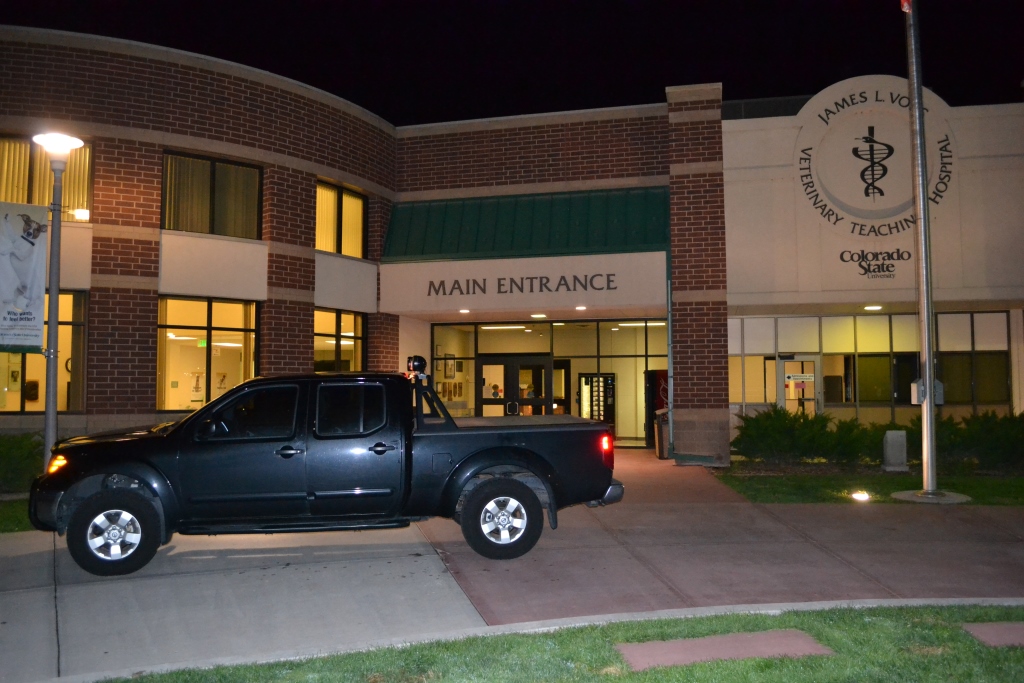
At 10:30pm, I arrived at Colorado State University lab in Fort Collins. Luckily for me the lab has a 24 hour drop off time to bring in animals. This is one of the reasons I picked this lab, and the other main reason is, it’s also the best veterinary lab in the state of Colorado. That is a biggie! After dropping off the animal to the late night attendant and filling out the proper paper work, I started my 2 hour drive back home to Colorado Springs arriving around 1:30am. What a day.
The next day at 2:30pm July 31st, I got a call from the lab doctor (name on file) and we discussed his findings while I asked other questions.

He saw the tongue was missing and the edge of the unknown cut was jagged. I asked him if he had ever seen this before, and he said no, that it appeared a little odd.
He saw the complete digestive track was missing from the stomach to the intestines including one of the kidneys. It looked as if they were all pulled out through a 10cm hole in the anal area. I asked him if this was common of what scavengers do, and once again he said he’s never seen this before and thought it was odd too!
There was no blood in the heart, but that could have been due to time of death when the heart was contracted.
Part of the lungs were inflated which meant the animal was alive and healthy at one time.
There was a 10cm hole in the anal area, the rectum was gone, and there was no blood around that area.
The pelvis was protruding through the 10cm hole.
Both eyes appeared to have been pecked out by birds. (This is common and was once a misconception of a standard mutilation.)
No predator or scavenger bites were located anywhere on the carcass.
Signs of maggets and larva were noticable. ( Larva eggs hatch within 24 hours so this carcass would have been older than 24 hours and probably closer to 30.
No excess amount of blood was found in the cavity of the carcass. (Generally a calf will have over 1 liter of blood.)
No cause of death determined.

Once thing that bothered me about the death was the noticeable lack of hemorrhaging and the lack of blood in the heart. If there were no noticeable signs of hemorrhaging, would this account for the lack of blood in the heart? If the heart was still pumping when the calf died, there should be signs of hemorrhaging. The calf could have pumped all the blood out of the heart on its last breath, then a scavenger could have come in later, but pull the complete digestive track out? Pull the tongue out? If this was a common trait with scavenger feeding, then the lab doctor wouldn’t have said he’s never seen that before.

Note: The lab doctor’s findings on the official report reflect just the necropsy lab results based on what they observed. It states what they found during the necropsy but not necessarily what’s missing. As professionals they won’t give their opinions officially because as scientists they must stay neutral in their work. Even though the doctor stated he had not seen certain characteristics in this animal compared to other animals in his career, we still have to leave the possibility open to natural scavenger causes for science’s sake.

The area in the field where the carcass was found showed slight signs of a possible anomaly on the terrain. I took soil samples which were sent out for analysis. At the time of this blog, the soil results are not available probably due to a possible back log of work at the lab. We’ve had some major weather issues here in Colorado lately.
The following is the official necropsy results from the university, any differences between the official report and my conversation with the lab doctor are due to added questions I asked after the report was filed. All expenses were paid by me, and I never charge the ranchers for my time in any of my investigations.

GROSS FINDINGS:
A neonatal bull calf was submitted for necropsy examination. The soft horn (slipper) was partially present on the front hooves. The carcass was severely autolyzed with marked subcutaneous and intramuscular emphysema. The eyes were bilaterally absent. The hair coat was extensively covered with maggot eggs and larvae. Maggot eggs and larvae were present in the oral cavity and in and around the rectum. The rostral two thirds of the tongue was absent and the remaining margins were jagged. No hemorrhage was observed at the edge of the remaining tongue. There was an approximately 10 cm in diameter hole around the regions of the rectum with irregular margins and no associated hemorrhage. The pelvis was partially extruded through the defect in the rectum. The skeletal muscle around the right femur was absent and there was no associated hemorrhage. The only abdominal viscera observed were the liver, left kidney, and a portion of the
abomasum. No significant lesions were observed in the thoracic or abdominal viscera.
Prelim: 7/31/13 CF
Full report: 8/1/13
L a b o r a t o r y F i n d i n g s / D i a g n o s i s
Standard Report(m) – 7/22/2010 Page 1